How an Opportunity Scan surfaced why users couldn't find the value that was already there.
Context
Teamscape is a bootstrapped B2B SaaS built around team dynamics assessment. It gives individuals and teams a structured way to understand how they work together — surfacing behavioural patterns and opportunities for better collaboration.
The product had genuine traction. A recent event drew around 25 attendees, and the real-time insights feature generated visible excitement in the room. The founders were sharp, the problem was validated, and the core IP was strong.
But users struggled with the experience. The product wasn't guiding them anywhere.
Challenge
Teamscape is built by an expert team of coaches and facilitators, not by designers or product people. The product is developed internally, with the help of a developer, to support the consulting work they already do.
They had a working product and real users. What they didn't have was a strategic outside perspective on the experience. No one on the team was positioned to step back and audit the product with fresh eyes, to map the friction points, question the assumptions, and identify what was quietly getting in the way.
They serve three distinct user types — individuals, managers, and HR professionals — across four validated use cases. Getting the experience right for all of them, without a designer or product lead in the room, was the core challenge.
That's why they came to me. They needed an expert to walk through the product, identify what was working and what wasn't, and give them strategic feedback they could actually act on.
Approach
The Opportunity Scan unfolded in three phases:
Phase 1: Pre-Session Briefing
The founders completed a briefing form covering product stage, target users, current challenges, and goals for the scan.
Phase 2: Product Mapping & Analysis
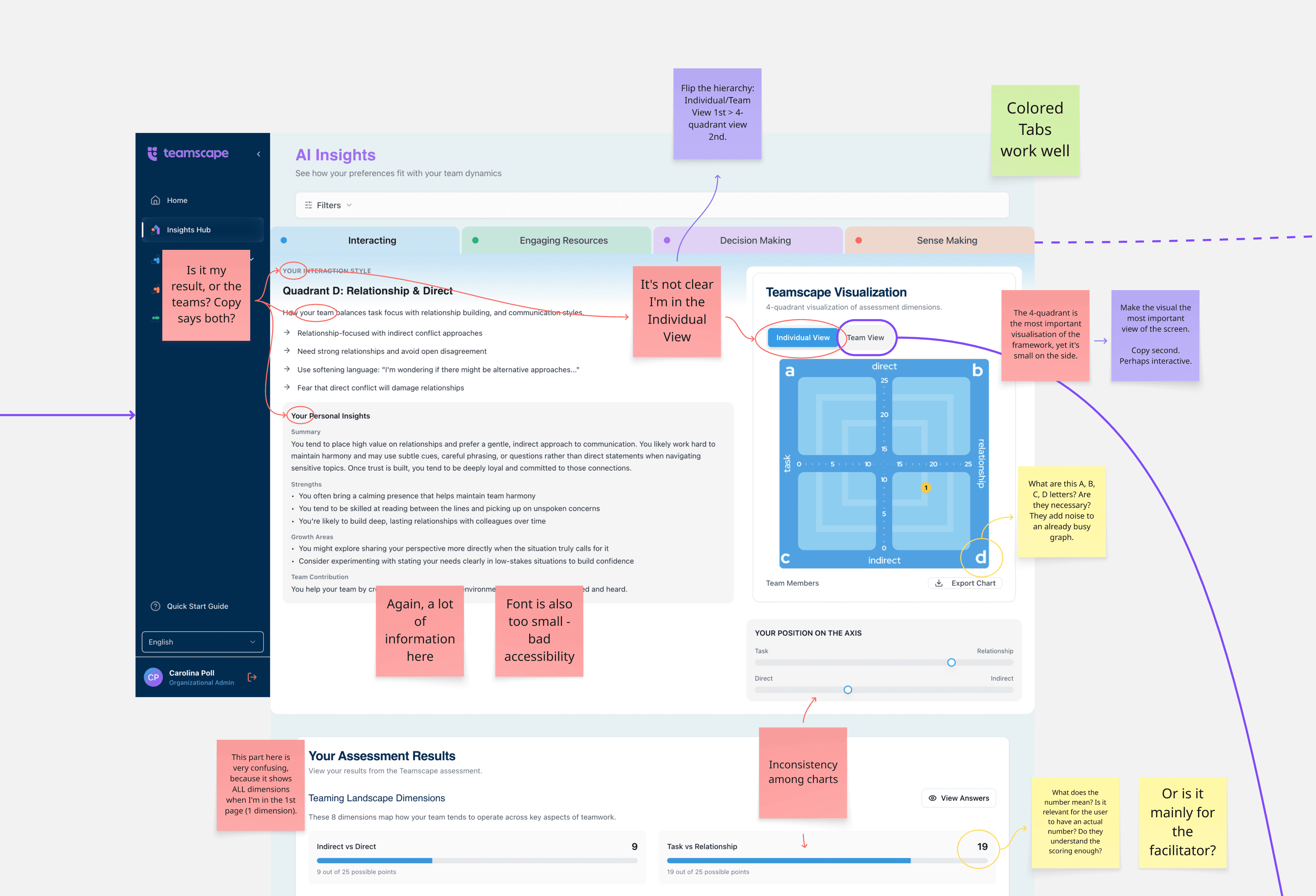
I walked through the product end-to-end and mapped the full experience in Miro, identifying friction points, broken flows, hierarchy issues, and navigation gaps across the assessment, dashboard, and post-login experience.
Phase 3: Collaborative Debrief (45 min)
I walked through the findings, the founders added context, and together we moved from symptoms to the underlying patterns.
The entire process took 5 workdays, with approximately 2 days of analysis in between.
Key Insights
The core asset was invisible.
Teamscape's quadrant visual is the heart of the framework, the single most important output of the product. When I navigated the dashboard, it was tucked into a corner, competing at equal visual weight with everything else on the screen. Nothing told me, or any new visitor, where to look first.
The first value moment was broken.
After completing the assessment, I hit a login screen with no context, no next step, and no sense of what came next. Instead of landing in a moment of insight, I landed in a dead end. That's the most fragile point in any product journey, and it was completely undesigned.
The "me to team" journey was invisible.
The toggle between individual and team views, one of the most critical navigational decisions in the product, was small, visually understated, and gave no indication of which mode was active. The shift from personal results to team insights is the core value of Teamscape. Walking through the product, I could easily miss it entirely.
Four use cases, one front door.
As I mapped the experience, a strategic tension emerged: four distinct use cases (embedded consulting, team conflict resolution, M&A cultural diagnosis, and senior hire onboarding) all entering through the same interface. Each one implies a different user with a different first question. The product couldn't answer all of them clearly, and in trying to, it risked answering none of them well.
Action Plan
Priority 1: Information Hierarchy & Dashboard Redesign
Elevate the quadrant visual as the centrepiece. Establish clear hierarchy so users immediately understand what the product is showing them.
Priority 2: First Value Moment & Post-Assessment Flow
Fix the authentication issue and design a deliberate path from assessment completion to first meaningful team insight.
Priority 3: The Me-to-Team Journey
Elevate the individual/team toggle as primary navigation. Give users a guided path from personal results to collective view — intentional, not accidental.
Outcomes
Before the Opportunity Scan:
Strong product with genuine traction, but low conversion after the assessment
Four use cases with no clear primary entry point
Core value proposition being lost in the interface
After the Opportunity Scan:
Clear diagnosis: three specific, fixable UX failures — not a product concept problem
Prioritised roadmap with a logical sequence for what to fix first
Shared language across the team for what was broken and why

Client Feedback
Project Manager, Teamscape
Reflections for Founders & Leaders
The Teamscape team had built something real. The problem was validated, the IP was strong, and the product was getting genuine engagement. This wasn't a bad product.
It was a product that couldn't show its own value.
What the audit made clear: the most critical moments in the experience had been left undesigned. Not because the team hadn't thought carefully about the product, but because when you're deep inside it, those gaps are nearly impossible to see.
A few things worth taking from this:
The screen right after something goes well is often the most neglected one. That post-assessment moment is where trust is highest and the product has the most to gain — or lose. It deserves as much design attention as the feature itself.
Visual hierarchy is how a product communicates confidence. When I audited the dashboard, nothing told me what mattered most. In a product built around a powerful visual framework, that's a missed opportunity to make an immediate impression.
If your core value proposition requires a shift in perspective, the product has to actively create it. The move from individual insight to team insight doesn't happen on its own. It needs to be designed, guided, and made impossible to miss.
Services
Opportunity Scan
Strategic Design
User Experience
Limited to 4 scans per month to ensure quality