How an Opportunity Scan uncovered why a product team was stuck—and what they actually needed to move forward.
Context
A 6-year-old event management SaaS company was at a turning point. With 70 employees, 2 designers, and 2 product managers, they'd built a platform to help entrepreneurs run photo booth businesses—from event creation to booking to customization.
But despite having a big user base, a team, systems, and resources in place, something wasn't working. The founder was reviewing every pixel. Features were taking too long. The team had the tools but struggled with execution and clients were struggling with the user experience.
Their goal: "Improve UI/UX and hopefully get insight on what type of team we need."
Challenge
The company served two very different user groups: new entrepreneurs with no tech experience, and seasoned event professionals (wedding photographers, DJs, planners). The platform needed to work for both.
The core tension:
Users weren't happy with the product experience. The founder had redesigned it himself once before, convinced it would be better. Users hated it. "It taught me what I like isn't what my customers like."
Now he questioned both his judgment and his team's output. He was stuck reviewing everything, but didn't know if the issue was the people, the process, the design approach—or something else entirely.
The real question: What's actually broken here—and what kind of support does this team need?
Approach
The Opportunity Scan unfolded in three focused phases:
Phase 1: Pre-Session Briefing
The founder completed a briefing form covering team structure, product stage, user types, and goals for the scan.
Phase 2: Product Mapping & Analysis
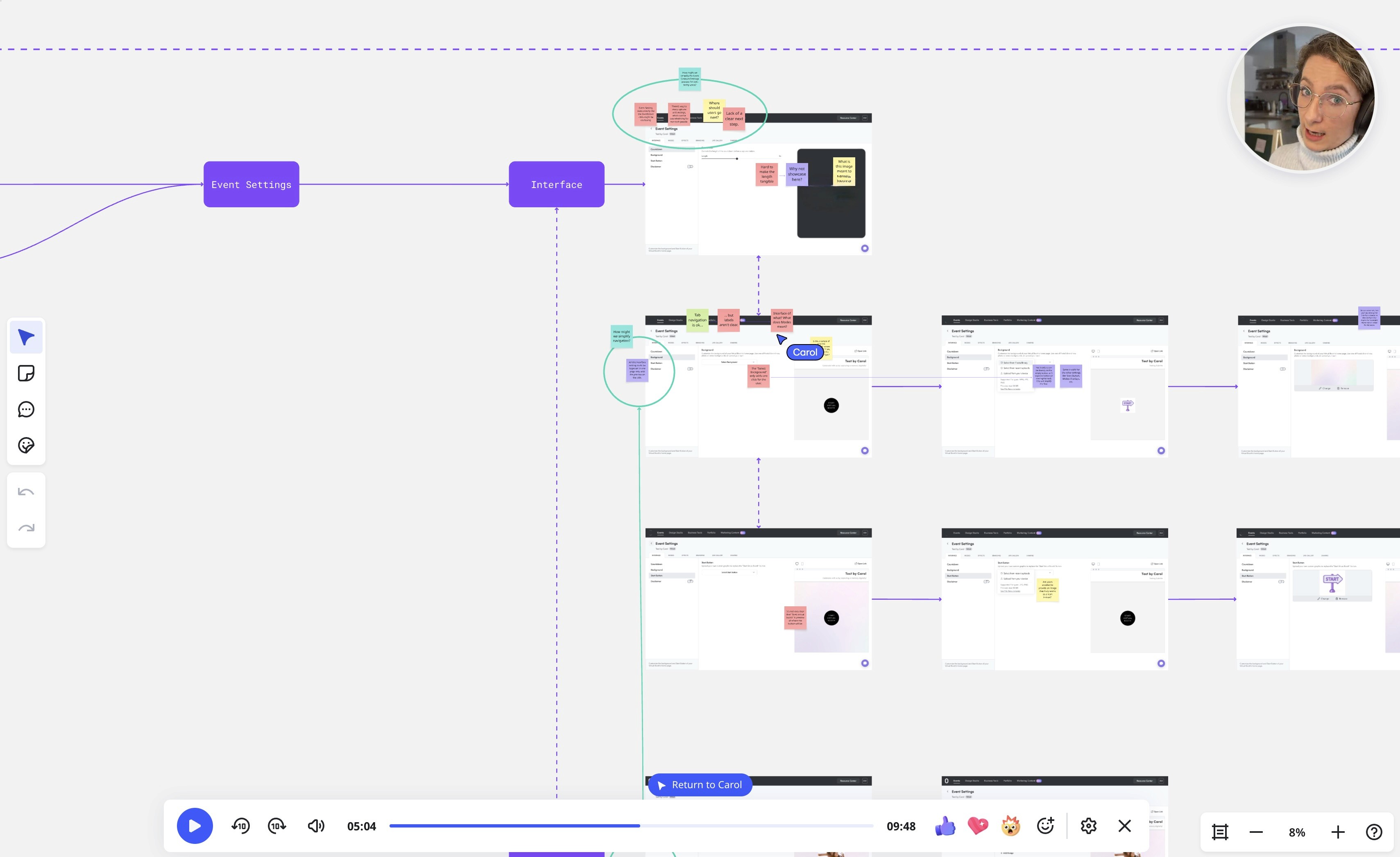
I walked through the platform and mapped the entire experience in Miro—identifying UX patterns, gaps in information architecture, consistency issues, and opportunities for improvement. I embedded a summary video in the board covering key findings and quick tips the team could act on immediately.
Phase 3: Collaborative Debrief (45 minutes)
I walked through the Miro analysis, the founder shared context, and we explored root causes together.
The entire process — from briefing to debrief — took 5 workdays, with approximately 2 workdays of analysis in between.
Key Insights
"You asked a lot of great questions. You have a good understanding of what problems we're going through."
Too much consistency was actually causing confusion.
The design system was being applied uniformly across the entire product. Event creation looked identical to settings, which looked identical to the dashboard. Users couldn't tell where they were or what mattered most in each context.
Insight: Components should be consistent. Experiences should be legible.
The one-stop shop trap.
The platform was trying to serve complete beginners alongside experienced professionals. Everything was possible, but nothing felt obvious. The problem wasn't feature count—it was the absence of clear default paths.
Reframe: Don't reduce features. Establish hierarchy. Make the simple things obvious and the complex things discoverable.
They didn't have a design problem—they had a design leadership problem.
The team had talented designers and solid tools. What they lacked was someone to set design vision, mentor on complex UX decisions, translate business needs into design solutions, and orchestrate everything into a coherent whole.
Pattern: Junior designers + No senior guidance = Founder becomes design QA
Quick wins alongside strategic priorities.
Beyond the three main priorities, the Opportunity Scan also uncovered smaller, actionable improvements the team could implement immediately—UI refinements, navigation tweaks, and onboarding adjustments that would improve the user experience right away while the bigger challenges were being addressed.
Action Plan
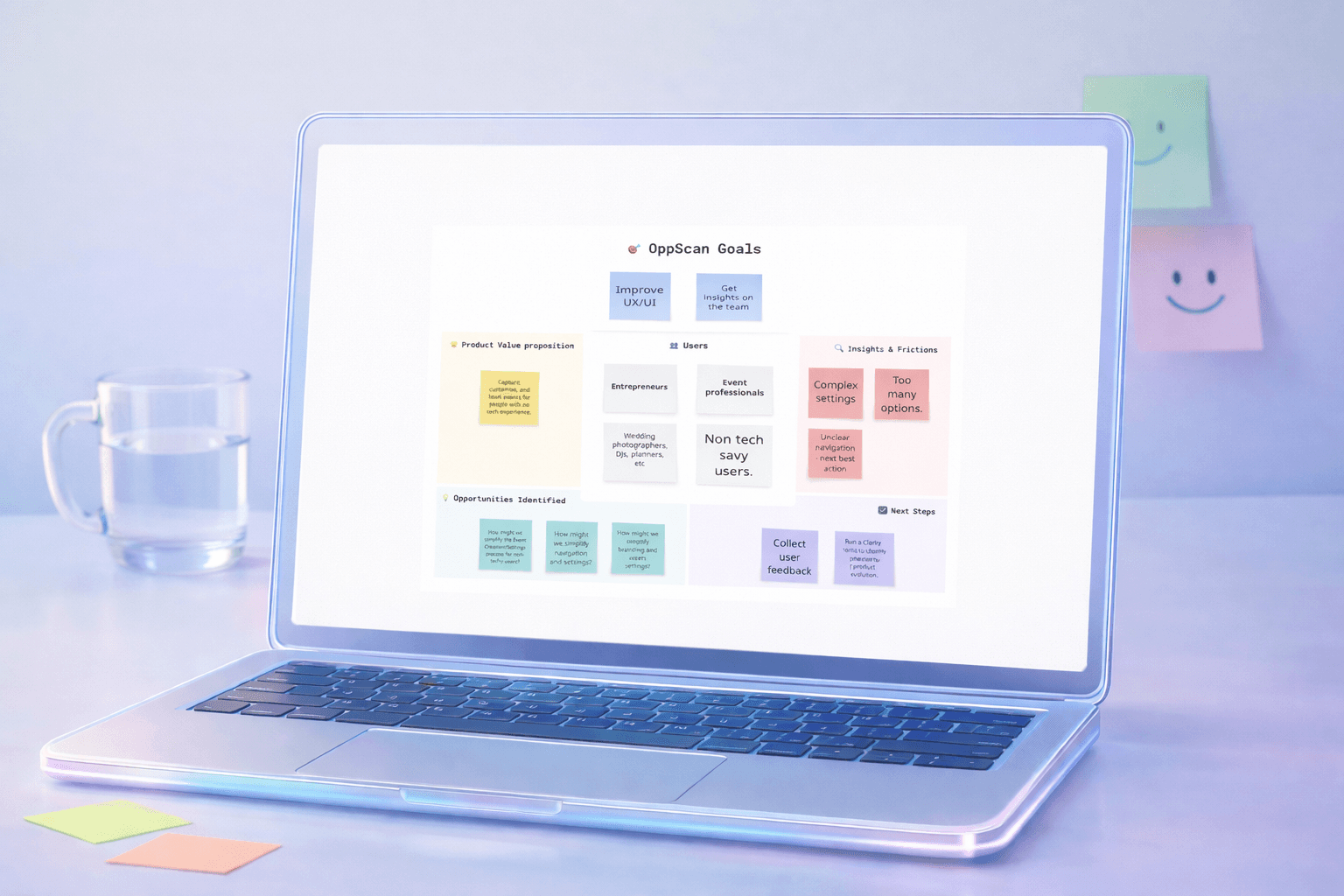
Based on the Opportunity Scan and the Debrief Call, we aligned on three priorities:
Priority 1: Process & Cross-Functional Alignment
Refine the emerging "vision kickoff" framework, establish clearer handoffs between product, design, and engineering, and reduce endless revision cycles through better initial clarity.
Priority 2: Design Leadership & Team Development
Provide fractional design leadership to mentor the junior team, create a product vision for where the platform should evolve, and develop the team's ability to make strong UX decisions independently.
Priority 3: Product Marketing Strategy
Elevate release communications from feature lists to compelling narratives, provide strategic direction to the external agency to reduce revision rounds, and create frameworks that maintain quality standards.
Outcomes
Before the Opportunity Scan:
"Something's wrong but we don't know what"
Unsure whether to hire, restructure, or change tools
Founder reviewing every detail
Users unhappy with the experience
After the Opportunity Scan:
Clear diagnosis: design leadership gap, not a talent gap
Three-priority roadmap with concrete next steps
Quick wins the team could act on immediately
Through the debrief discussion, we identified that fractional design leadership was a better fit for their needs
Confidence to move forward with partnership
The Opportunity Scan is evolving into an ongoing fractional design leadership engagement to implement the roadmap, mentor the design team, refine processes, and elevate product marketing.
The founder rated the experience 5/5 and confirmed it fully met expectations, with high confidence about next steps.

Client Feedback
Event Management SaaS Founder
Reflections for Founders & Leaders
An Opportunity Scan is more than a design audit.
Yes, it reveals UX friction and improvement opportunities. But it goes deeper—uncovering the bigger challenges behind how the product is designed, built, and brought to market.
The pattern this founder faced:
Users weren't happy → Founder redesigned it himself → Users still weren't happy → Founder lost trust in his own judgment and his team's output → Got stuck reviewing everything.
The Opportunity Scan showed this wasn't a design execution problem—it was a design leadership gap. The team had the skills; they lacked the guidance, vision, and strategic direction to apply them effectively. Initially, I had suggested a Clarity Sprint to address the three priorities. But through the collaborative debrief conversation, it became clear that what this team needed wasn't just a sprint—it was ongoing design leadership.
That's the value of the process: it helps you find the right solution, not just a solution. After evaluating 20+ design firms, the Opportunity Scan helped him see a different path: "I didn't even think you could hire a fractional design. That's a smart idea."
Services
Opportunity Scan
Product Design Strategy
Product Design Audit
Fractional Design Leadership
Limited to 4 scans per month to ensure quality